Best HWID Spoofer Guide for 2026
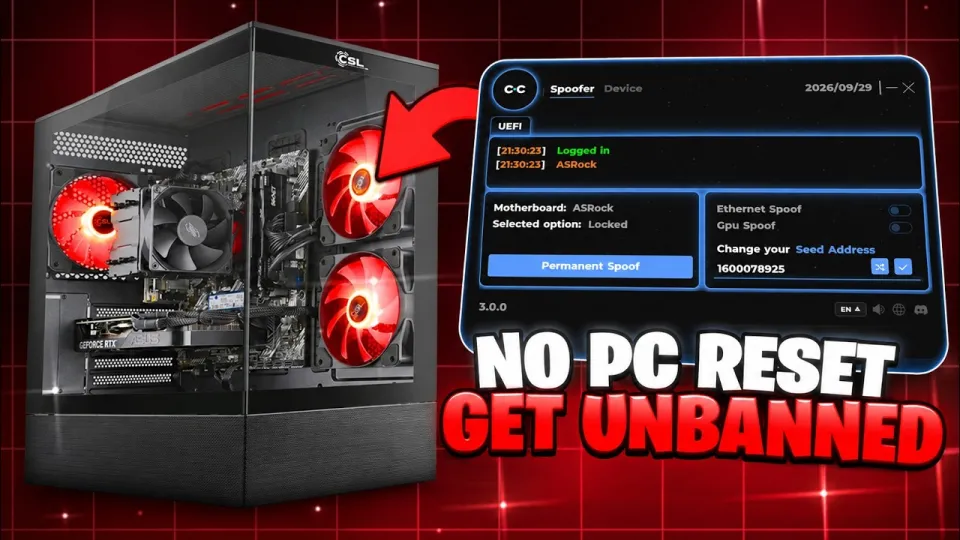
Video: The Ultimate HWID Spoofer Tutorial 2026 – Full Guide To Get Unbanned Fast
· based on the channel clixx
Key takeaways
- An HWID spoofer replaces the hardware identifiers a game's anti-cheat uses to recognise a banned machine, so a new account can run on the same PC.
- The build covered in the clixx tutorial is distributed through cethcheats.cc and its Discord server, with coupon code DENYS for 5% off.
- Listed supported titles include Fortnite, Warzone, Rust, CS2, Rainbow Six Siege, Apex Legends and Valorant.
- Spoofing does not remove a ban from an account: the banned account stays banned, only the hardware fingerprint changes.
- Kernel-level anti-cheats such as Vanguard and Easy Anti-Cheat can flag spoofers that fail to clean up serials, MAC addresses and disk identifiers consistently.
The best HWID spoofer in 2026 is a tool that changes the hardware identifiers an anti-cheat reads from your PC, so a banned machine looks like a different one to the game. The build walked through in the clixx tutorial is sold through the Ceth Cheats store, where you can buy a licence, and it lists Fortnite, Warzone, Rust, CS2, Rainbow Six Siege, Apex Legends and Valorant among supported titles. It does not unban an account; it changes the fingerprint behind the ban so a fresh account can run on the same hardware.
What an HWID ban actually blocks
An HWID ban is a block placed on the physical components of your machine rather than on the account, which is why making a new account does not help on its own. Anti-cheat clients collect a fingerprint built from several sources: the motherboard and BIOS serials, the volume serial number of each drive, the SMBIOS UUID, the machine GUID in the Windows registry, the MAC address of the network adapter, and sometimes the monitor's EDID data or the raw disk serial. When a detection fires, that fingerprint is stored server-side and every new account launched from the same hardware is refused or flagged.
A spoofer works by intercepting or rewriting those values before the game's anti-cheat reads them. There are two broad approaches:
- User-mode spoofing changes registry keys, volume serials and some SMBIOS strings through normal Windows APIs. It is simpler and safer for the system, but kernel-level anti-cheats can often see through it.
- Kernel-level spoofing loads a driver that hooks the routines anti-cheats use to query hardware, returning fake values at the source. This is what most paid spoofers, including the one shown in the tutorial, rely on.
A permanent spoofer writes the changes so they survive reboots until you revert them; a temporary spoofer applies them only for the session and restores the originals afterwards. Neither type touches your actual game account, and neither restores a banned account.
Features and configuration in the clixx walkthrough
The tutorial opens with an interface tour before any installation, which is the right order: you see what the tool exposes before it touches your system. The overview covers the main spoofing modules and the system tools bundled with them, followed by the configuration screen where individual hardware categories can be toggled.
Typical options in a build like this include:
- Disk and volume serials – the most commonly checked identifier after the motherboard.
- SMBIOS and motherboard data – system UUID, board serial, BIOS version strings.
- Network adapters – MAC addresses for each active interface, including virtual ones.
- Registry identifiers – MachineGuid and related keys tied to the Windows install.
- Cleanup options – traces such as recent connection logs, temp files and event entries that anti-cheats cross-reference.
The configuration step matters more than the install itself. Spoofing one category but leaving another untouched produces an inconsistent profile, and an anti-cheat that compares a spoofed disk serial against a real motherboard serial will flag the mismatch faster than an outright ban would. If the tool offers a preset for a specific game, use it rather than mixing categories manually.
Installation and setup order
The installation segment of the video is short, and that reflects how these tools are meant to work: driver installation, a reboot, then configuration. A practical order for any spoofer looks like this:
- Disable antivirus real-time protection temporarily, since kernel drivers are routinely quarantined as false positives.
- Create a Windows restore point or a full system image before running anything.
- Run the installer as administrator and allow the driver to load; reboot when prompted.
- Open the configuration panel and select the identifiers to change, or load a game preset.
- Apply the spoof, then verify the new values with a tool like a hardware info utility before launching the game.
- Launch the game on a fresh account, never on the banned one.
Skipping step 2 is the most common mistake. A spoofer that writes to disk serials or SMBIOS can leave a machine in a state that is awkward to recover without a backup, and reverting is not always a single click.
Supported games and what to expect per title
The store page and the tutorial both list Fortnite, Warzone, Rust, CS2, Rainbow Six Siege, Apex Legends and Valorant, plus FiveM and other titles in the tags. Compatibility is not uniform across that list, because the anti-cheats differ sharply.
- Fortnite and Apex Legends run Easy Anti-Cheat, which reads a broad set of hardware values but is generally considered more forgiving of clean spoofs than kernel-level rivals.
- Valorant runs Vanguard, a kernel driver that loads at boot and is the most aggressive of the group; spoofing for Valorant is where most failures and re-bans are reported.
- Rust uses Easy Anti-Cheat plus its own server-side checks, and community servers often add their own bans on top.
- CS2 relies on VAC, which historically leans on account and trust-factor signals more than raw hardware data.
- Rainbow Six Siege uses BattlEye, which sits between EAC and Vanguard in strictness.
A spoofer that works cleanly on Fortnite can still be detected on Valorant. Treat any "works on everything" claim with scepticism and check the vendor's current status notes for the specific title you play.
Limits, risks and how to judge a spoofer
No spoofer guarantees permanent access, and the honest way to evaluate one is by how it handles failure. Three things separate a usable tool from a bad one: whether it spoofs every identifier the target anti-cheat reads, whether it cleans traces as well as changing values, and whether the vendor ships updates after anti-cheat patches. Vanguard and BattlEye update their detection routines regularly, and a spoofer that is not maintained goes stale within weeks.
Practical risks to weigh before buying:
- Re-bans. A partial or detected spoof usually results in a faster, longer ban on the new account.
- System stability. Kernel drivers can conflict with other security software, and a bad write to SMBIOS can affect boot.
- Account loss. Bought accounts and boosted progress are lost when the new account is caught.
- Terms of service. Spoofing violates the rules of every game listed, and publishers can extend bans to linked accounts and payment methods.
Price is a weak signal. A cheap or free spoofer that only edits registry keys will fail against Vanguard on the first launch, while a maintained paid build with per-game presets and update logs is doing the work that actually matters.
Where to get the tool and its community
The build shown in the breakdown is distributed through the vendor's store and its Discord, which is also where support and status updates are posted. Both links from the video are listed here:
- Store and product page: https://cethcheats.cc/
- Discord community and support: https://discord.gg/ceth
The video description also includes coupon code DENYS for 5% off at checkout. Before buying, check the Discord for the current detection status of your specific game, since that channel is where stale builds are usually called out first.
Conclusion
The best HWID spoofer is the one that covers every identifier your target anti-cheat reads, cleans traces as well as it rewrites serials, and gets updated after each anti-cheat patch. The clixx tutorial is a useful walkthrough of one such build, covering the interface, the configuration categories, the driver install and the supported game list, and it is honest about the fact that spoofing changes hardware fingerprints rather than restoring accounts. If you want to try that build, start at the Ceth Cheats store, confirm the current status for your game in the Discord, and back up your system before running anything. For more breakdowns of spoofers and anti-cheat behaviour, the clixx channel is the source of this one.
Questions & answers
Does an HWID spoofer unban my game account?
No. A spoofer changes the hardware identifiers your PC reports, so the machine looks new to the anti-cheat. The banned account itself stays banned permanently, and you need a fresh account to play after spoofing.
Which games does the spoofer in the tutorial support?
The vendor lists Fortnite, Warzone, Rust, CS2, Rainbow Six Siege, Apex Legends and Valorant, with FiveM also appearing in the tags. Compatibility differs by anti-cheat, so check the current status for your specific title before buying.
Is a free HWID spoofer as good as a paid one?
Usually not. Free tools tend to edit only registry keys and volume serials in user mode, which kernel anti-cheats like Vanguard and BattlEye can detect quickly. Paid builds that load a driver and receive regular updates are more likely to survive a patch.
What should I do before running an HWID spoofer?
Create a system restore point or full image, disable antivirus real-time protection so the driver is not quarantined, and run the installer as administrator. Verify the new hardware values before launching the game on a fresh account.
Source: The Ultimate HWID Spoofer Tutorial 2026 – Full Guide To Get Unbanned Fast · Markdown version